Offline-first archival transcription & analysis
From difficult recordings
to traceable records.
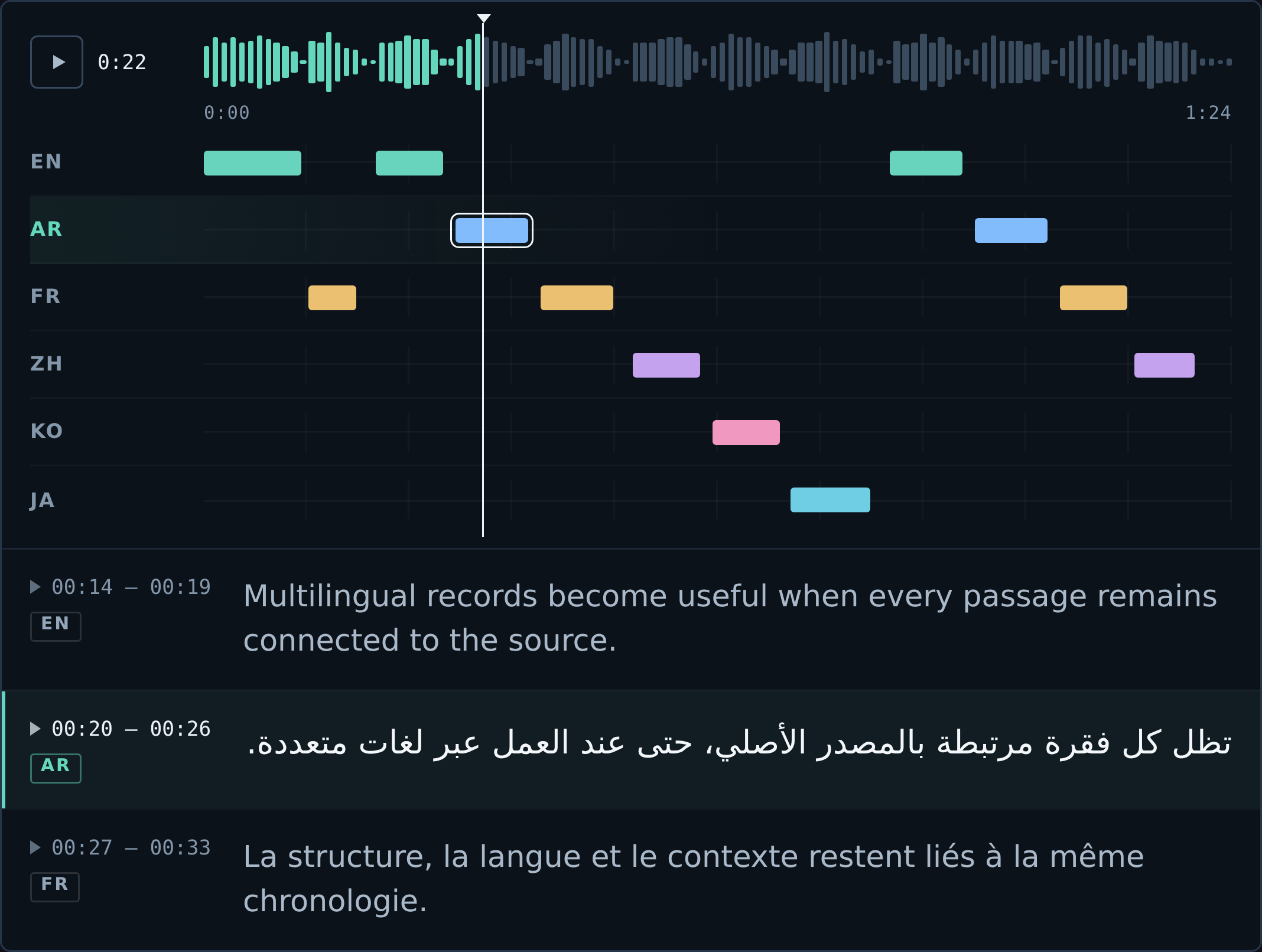
Multilingual transcription and analysis for archives, libraries and research. Every passage links back to the audio.
Offline-first archival transcription & analysis
Multilingual transcription and analysis for archives, libraries and research. Every passage links back to the audio.
Standard transcription systems perform best with clean speech, predictable speakers and controlled recording conditions. Archival material rarely offers that simplicity.
R2 Mechanics is built for difficult audio, complex speaker structures, multilingual material and long-form archival collections.
01
Degraded recordings, analogue transfers, unstable levels, background interference and historical source material where conventional transcription reaches its limits.
02
Interviews, hearings and multi-speaker recordings where reliable speaker attribution is essential and automated diarization alone is not enough.
03
Language changes within a recording can be mapped alongside speaker structure and source timing. Identified language regions can be processed through language-appropriate paths and then reunited on one continuous, searchable source timeline.
This allows multilingual recordings to retain their original conversational and thematic continuity rather than being divided into disconnected language-specific transcripts.
04
Long-form recordings and collections can be processed as structured projects rather than as one continuous manual review task. Analysis maps and diagnostic signals help identify difficult passages early, so additional processing and expert review can be focused where they are actually needed.
Your original is never overwritten. A controlled processing copy is created and documented. Every derivation from the source material is traceable.
Multiple independent recognition and speaker-analysis paths examine the material. Agreements strengthen the evidence; differences and uncertainties remain visible in the documented result.
The validated transcript is selected through a controlled, traceable review process. Project workflows can include documented expert review before final delivery, depending on scope and delivery requirements.
Long-form collections, legacy recordings and archival holdings requiring structured transcripts, navigable records and documented provenance.
Oral history, academic interviews and research collections requiring speaker attribution, citable timestamps and separate reading versions.
Hearings, institutional interviews and sensitive collections requiring controlled local processing, documented handling and reviewable outputs.
Long interview material requiring chapter navigation, speaker labels, searchable transcripts and production-ready export formats.
R2 Mechanics is a member of NVIDIA Inception, supporting our continued development of advanced speech and audio analysis for specialised workloads.
© NVIDIA, the NVIDIA logo, and NVIDIA Inception are trademarks and/or registered trademarks of NVIDIA Corporation in the U.S. and other countries.
Every project begins with an assessment of the source material, its technical conditions and the result you need. From there, we define the processing scope and deliverables.
Discuss your collection →